
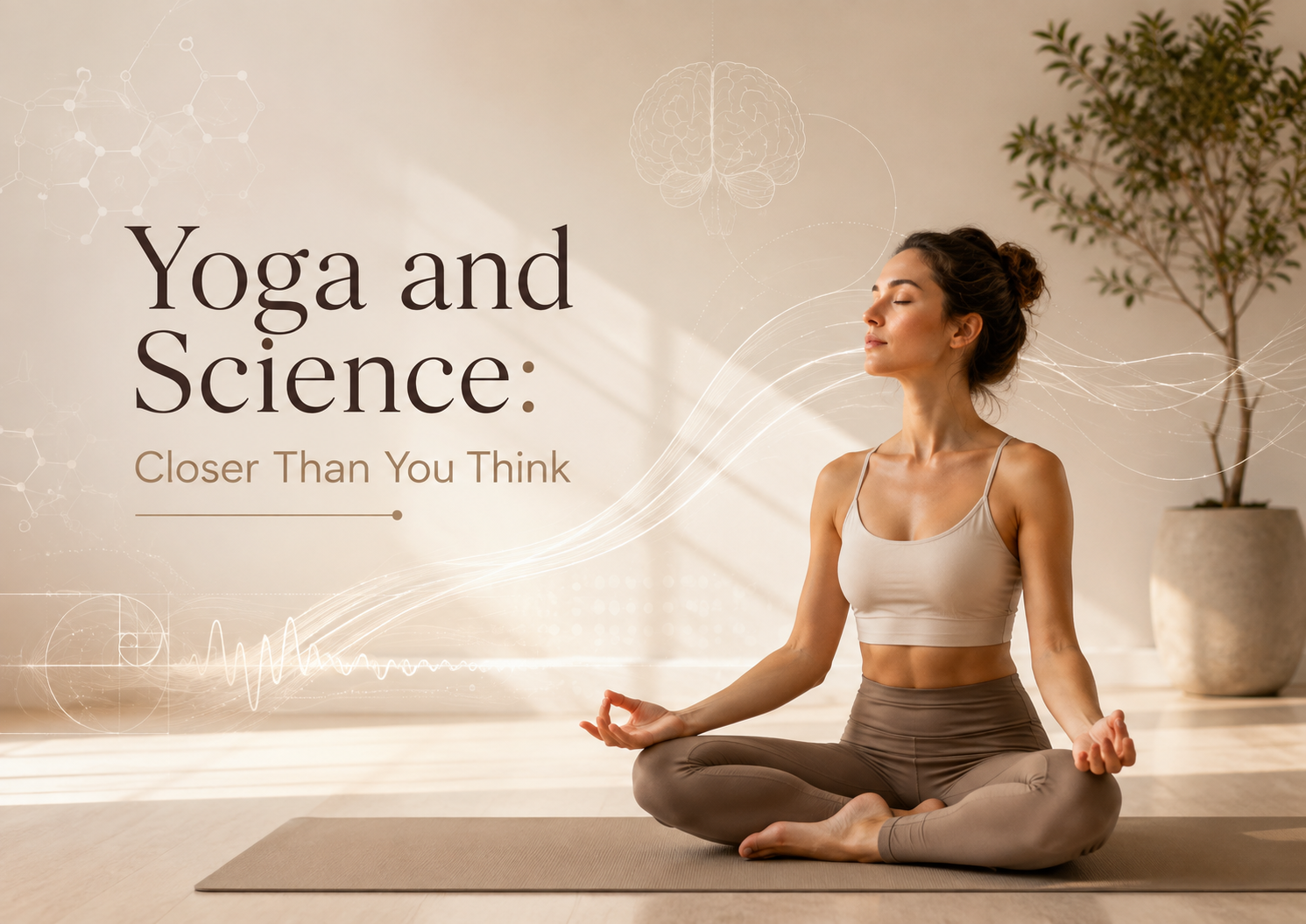
Yoga and science may seem like very different worlds.
One has ancient roots, Sanskrit names and a lot of time spent barefoot.
The other has laboratories, data and people in white coats.
But look a little closer, and they have something important in common: curiosity about how we work.
Yoga asks us to observe the breath, the body, the mind and our reactions.
Science does something similar. It observes, tests, questions and looks for patterns.
Different methods. Similar curiosity.
Your Breath Really Does Matter
Yoga has always placed the breath at the centre of practice.
And modern research is increasingly interested in the same question: what happens when we change the way we breathe?
The answer is that breathing can influence our nervous system, attention and emotional state.
Anyone who has arrived at class stressed, rushed or distracted and left feeling slightly more human has probably already noticed this.
Yogis did not have brain scanners. They did, however, pay very close attention.
Your Body and Mind Are Not Separate Departments
Stress is not only a thought.
It can be a tight jaw, shallow breathing, tense shoulders or a racing heart.
Yoga has always worked with the person as a whole. Movement affects breath. Breath affects attention. Emotions change how we hold the body.
Science is also increasingly exploring this connection, including interoception: our ability to notice what is happening inside the body.
Yoga asks us to practise exactly that.
Where am I tense?
Am I holding my breath?
Is this sensation challenging, or is it painful?
Do I actually need to push harder?
The more we notice, the more choice we have.
Attention Is a Practice
One of the biggest myths about yoga and meditation is that you are supposed to stop thinking.
Good luck with that.
The practice is not never getting distracted. The practice is noticing that your mind has wandered and bringing it back.
To the breath.
To the body.
To the moment.
Again and again.
Modern neuroscience calls the brain’s ability to adapt through experience neuroplasticity.
Yoga has a simpler message: what you practise matters.
The Yoga Mat Is a Small Laboratory
Every practice is a little experiment.
What happens when I slow down?
What happens when I breathe instead of react?
Can I stay present when something feels difficult?
Can I soften effort without giving up?
The results will not always be the same, because neither are we.
And perhaps that is where yoga and science meet most beautifully.
Both ask us to stay curious.
To observe.
To question assumptions.
To keep learning.
Science helps us understand what may be happening in the brain and body.
Yoga helps us experience it for ourselves.
What we notice, we can understand. What we understand, we can begin to change. And what we practise, again and again, has the power to shape who we become.